Standard Drum Motor vs Gearless Direct Drive: What Is Inside the Drum?
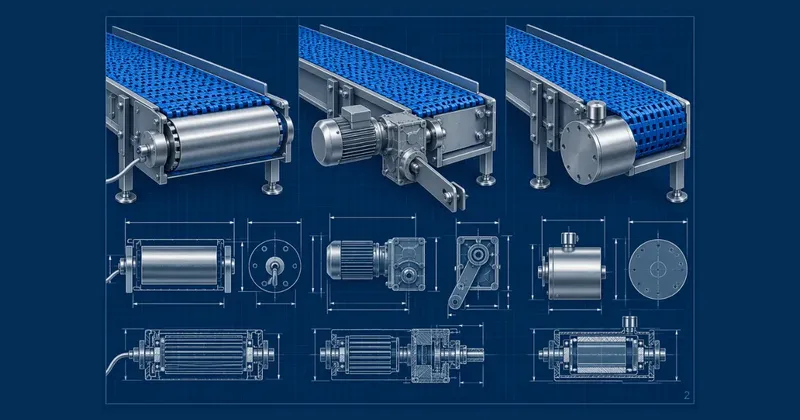
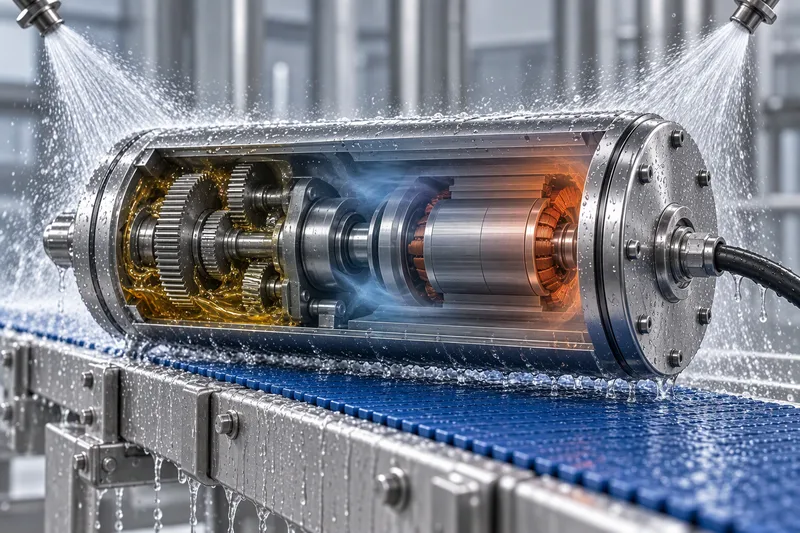
A standard drum motor packs an induction motor, a multi-stage gearbox and an oil bath inside a sealed pulley. The oil lubricates the gears and carries heat to the shell. In washdown, that heat and oil drive thermal breathing, leaks and frequent service. A gearless direct drive pulley like One Motion PulleyDrive makes torque directly at the shell, with no gears and no oil inside.
What is inside a standard drum motor?
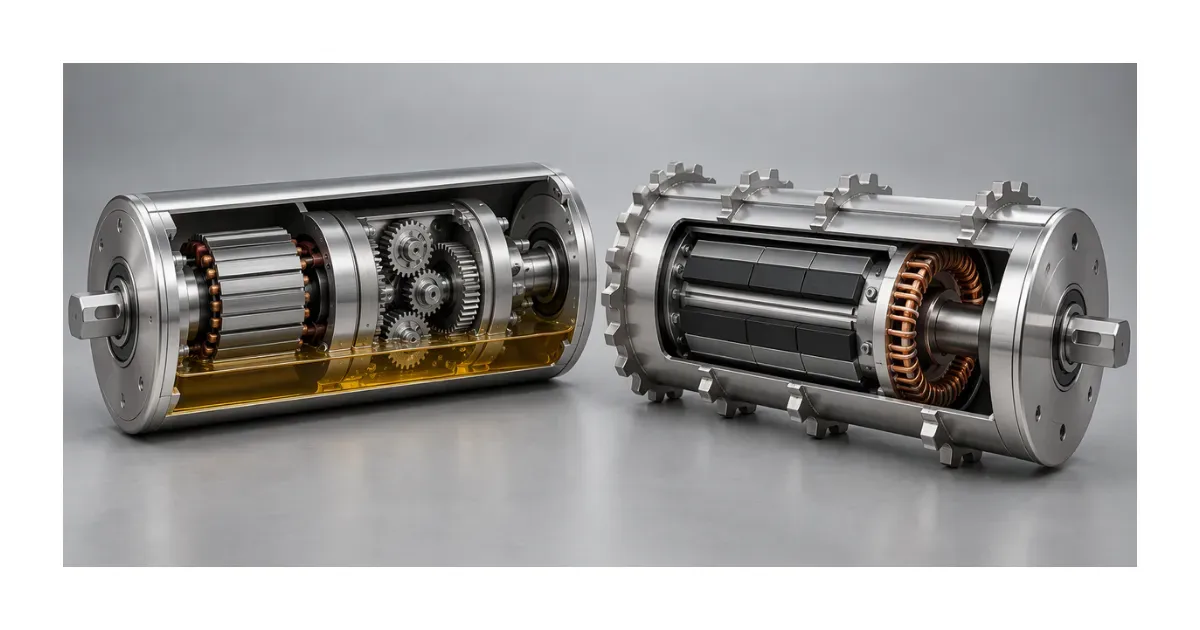
A drum motor, also called a motorized pulley, puts the whole conveyor drive inside the head pulley. Open a standard unit and you will find four things sealed in one rotating tube.
-
An induction motor fixed to a stationary shaft, spinning at high speed.
-
A gearbox, usually two or three planetary or helical stages, that reduces motor speed to belt speed and multiplies torque.
-
An oil bath that lubricates the gears and bearings.
-
Bearings and shaft seals at each end, which hold the oil in and keep water out.
The motor drives the gearbox, the gearbox drives the shell and the shell drives the belt. From the outside it looks compact and tidy. All the complexity is hidden inside.
Why does a standard drum motor need oil?
The oil does two jobs. First, it lubricates the gear teeth and bearings, which run continuously under load. Second, it carries heat. An induction motor and a gearbox both waste energy as heat, and a sealed drum has no fan. The oil splashes against the inside of the shell and moves heat from the windings and gears to the outer surface, where the belt and surrounding air carry it away.
That is why oil level and belt wrap both matter so much in drum motor manuals. Too little oil and the gears and windings run hot. Too little belt contact and the shell cannot shed the heat the oil brings to it.
What does the gearbox inside the drum do?
An induction motor makes modest torque at high speed. A conveyor belt needs high torque at low speed. The internal gearbox bridges that gap with a fixed ratio. Each ratio gives one belt speed at the motor’s base frequency, which is why drum motor catalogs list the same diameter many times over, each with a different ratio and speed.
A VFD can trim speed around that point, but the gearbox decides the working window. If production needs a very different speed later, the answer is often a different drum motor.
What happens to a standard drum motor in washdown?
In a dry warehouse, a standard drum motor can run for years. In a food plant, sanitation changes everything. During production the motor, the gears and the churning oil heat the drum, and the air and oil inside expand. When sanitation starts, cold water and chemicals hit a hot shell. The air inside contracts, internal pressure drops below the room around it, and the drum draws in whatever sits at the seal lip. That is thermal breathing.
Repeat it once or twice a day and water collects in the oil. The oil emulsifies and turns milky, lubricates poorly and lets bearings and gear teeth corrode. Seals harden from heat and chemicals. When the drum heats again, expanding oil and air push outward through the same worn seals. The symptoms plants see are oil on the belt, thermal trips, bearing noise and a unit sent out for rebuild.
How does a gearless direct drive pulley make torque without gears or oil?
A gearless drive is designed to make high torque at low speed on its own. PulleyDrive does it with an outrunner layout. The stator sits fixed on the inside, and a high-density array of permanent magnets is mounted on the inside of the rotating shell. The shell itself is the rotor. With a high pole count and a large air gap diameter, the motor produces belt-driving torque directly where the belt runs.
There is no gear train to lubricate, so there is no oil. A permanent magnet rotor carries its own field, so it avoids the rotor losses of an induction motor. With no gear friction and no oil churning, the motor is the only heat source. One Motion drives are designed for no more than a 50 degree Fahrenheit rise at full load, which keeps the pressure swing behind thermal breathing small. On One Motion powered pulleys the shaft runs all the way through, so the seals never carry torsional load.
What changes on the line when you remove the gears and the oil?
-
No oil to change, top up, drain or contaminate, and nothing inside that can leak onto product.
-
No gear wear and no backlash, so start, stop and indexing respond immediately and repeatably.
-
One unit covers a wide speed window, because speed is set in the VFD rather than by a fixed ratio.
-
Less internal heat, which slows seal ageing and shrinks thermal breathing during sanitation.
-
Belt load reaches the motor directly, which is what makes current-based monitoring with One Motion Cortex possible.
Key takeaways
-
A standard drum motor contains an induction motor, a multi-stage gearbox and an oil bath inside the pulley.
-
Heat from the motor, gears and oil drives thermal breathing, water in the oil and seal leaks in washdown.
-
A gearless direct drive pulley removes both the gearbox and the oil, so nothing inside can leak onto product.
Frequently asked questions
What is inside a standard drum motor?
An induction motor, a multi-stage gearbox, an oil bath, bearings and shaft seals, all sealed inside the rotating pulley shell.
Why does a drum motor need oil?
The oil lubricates the internal gears and bearings and carries heat from the motor and gearbox to the shell, where the belt and air remove it.
Why do standard drum motors leak in washdown?
Hot running followed by cold sanitation creates a pressure swing that pulls water past the seals and later pushes oil out. Heat and chemicals also harden the seal lips.
Does PulleyDrive need a special drive?
No. It runs on standard VFDs that support permanent magnet motors, such as the Allen-Bradley PowerFlex 525, with no encoder required.
Can PulleyDrive replace a standard drum motor?
Yes. It is offered in standard diameters and face widths with laser-welded sprockets matched to your belt, and stock sizes ship from Rogers, Arkansas in about 10 days.
Found this useful? Share it with your team.