Direct-Drive Delta Robot: Why We Replaced the Servo and Gearbox at the Shoulder
In a conventional delta robot, each upper arm is swung by a high-speed servo driving through a precision gearbox. DeltaDrive replaces that shoulder with the One Motion Powered Hub, an outer-runner direct drive rated at 120 Nm peak torque. The upper arm bolts straight to the rotating shell, so there is no gearbox, no high-speed servo and no reduction stage.
What did we show at PACK EXPO?
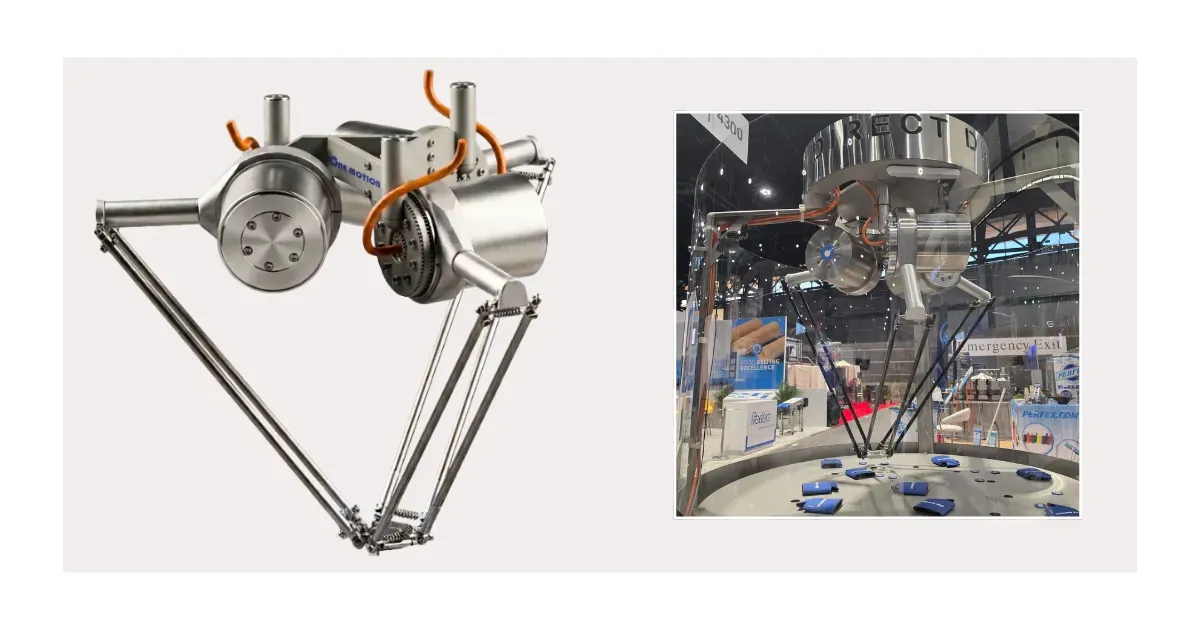
At PACK EXPO this fall, we showed a delta robot built on Rolumac mechanical hardware with one key change at the shoulder. Instead of a servo and gearbox swinging each upper arm, we used the One Motion Powered Hub, a direct drive rotary motor rated at 120 Nm peak torque. The outside of the hub turns, and the upper arm mounts directly to it.
We expected technical questions. We did not expect the crowd. Engineers, OEMs and end users kept stopping because the robot looked different. The motor housing itself rotates, and there is no gearbox hanging off the base. Most people asked the same thing: how can a motor turning that slowly keep up?
That question is the reason for this article. We are building something for the delta robot industry, and we want to share the journey as it happens: what we are building, why we think it matters and what we are learning along the way.
How does a delta robot work?
A delta robot has three identical arm chains hanging from a fixed base. Each chain has two parts.
-
The upper arm, a rigid link that pivots at the shoulder joint on the base. It is the only driven part of each chain.
-
The forearms, a pair of parallel rods that connect the end of the upper arm to the moving platform below and keep it level as it travels.
Every pick, place and settle starts with torque at the three shoulders. Whatever drives the shoulder sets the limits for the whole machine.
How is a conventional delta robot shoulder driven?
In most delta robots today, each shoulder uses a servo motor and a precision gearbox. The servo runs fast, typically up to about 3,000 rpm, and the gearbox trades that speed for the torque needed to swing the upper arm. The design works and has served the industry well. It also carries costs that rarely get discussed.
-
Every move starts with spin-up. Before the arm can move, the servo rotor has to accelerate to high speed. Pick and place is all starts and stops, so the motor is constantly speeding up and slowing down a rotor whose inertia the gearbox multiplies on its way to the shoulder.
-
Energy goes into motion that is not the work. Much of the electrical energy accelerates and brakes the motor’s own rotor instead of moving product.
-
The drive train adds compliance. Torque travels from a small rotor through couplings, gear mesh and a small output shaft before it reaches the arm. Each element adds a little torsional flexibility that the control system has to compensate for, especially as the arm settles.
-
Gearboxes wear and need maintenance. In a washdown food plant, a gearbox at every shoulder is one more component to seal, lubricate, clean and eventually replace.
Is the gearbox really the weak link?
Before we built anything, we asked food processors who run delta robots every day what they deal with. Our first survey of these end users pointed to the gearbox as the weak link in the delta robot, both in the past and today.
Robot builders told us something different. In their view, the gearbox is not a problem. It is a proven, well-understood part of the design.
We think both views are honest, and the reason they differ matters. Builders have never had a lasting, practical alternative at the shoulder. When nothing else is proven, you use the best component available, engineer around its limits and accept it. Over time, a limitation you cannot remove stops looking like one. It simply becomes how delta robots are built.
End users see it from the floor. They wash the robots down, schedule the maintenance and live with the downtime. From where they stand, the gearbox is a problem. We believe there is a real issue here. What has been missing is an alternative that lasts.
Has direct drive been tried on delta robots before?
Yes, and it would be wrong to suggest otherwise. An earlier effort brought direct drive motors to the delta robot industry using a large-diameter inner-runner motor. The coils sat on the outside, encased in aluminum to help shed heat, and the rotor turned on the inside. It was a reasonable design, and it showed the industry was open to a gearless shoulder.
That company has since stopped operating. Others have tried to continue the work, but we do not see them in the market in any meaningful way today. So the idea of a direct drive shoulder is not new. What has not happened yet is a direct drive shoulder that holds up in the market, and we think motor architecture is a big part of why.
Why use an outer-runner motor at the shoulder?
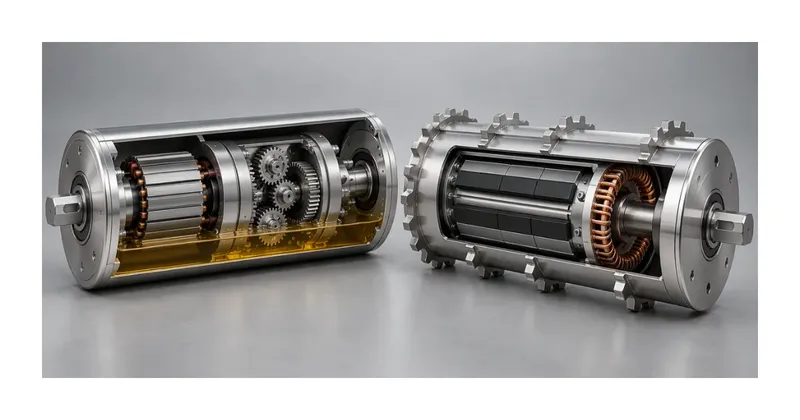
The Powered Hub flips the inner-runner layout. The stator and coils sit on the inside, bolted to the robot base. The magnets ride on the inside of an outer shell, and that shell is what turns. We believe this suits the delta robot shoulder better for three reasons.
-
More torque from the same envelope. Torque is produced at the air gap, and in an outer-runner motor the air gap sits at a larger radius for the same outside diameter. More radius means more torque without a bigger motor.
-
The rotating part is the mounting point. In an inner-runner motor, torque still has to leave through a shaft or hub before it reaches the arm. In the Powered Hub, the rotating shell is the output, and the upper arm bolts straight to it.
-
A proven platform behind it. Our outer-runner, high-pole-count motors have run in food plants since 2014 across the SideDrive, PulleyDrive and MagDrive product families. DeltaDrive builds on that foundation rather than starting from scratch.
The inner-runner design has real strengths, especially in pulling heat out through an aluminum-encased stator. Thermal performance at the shoulder is one of the things we are measuring closely.
What changes when the motor becomes the root of the arm?
One Motion’s Direct Drive Rotary Motion (DDRM) technology starts from a different place than the servo and gearbox. The upper arm bolts directly to the Powered Hub’s rotating shell. The motor no longer sits behind the arm driving it through a gearbox. It becomes the root of the arm.
Torque is produced at the large diameter of the shell and delivered straight into the upper arm. With no gearbox, motor speed equals arm speed, so nothing has to be spun up and geared down. Compared motor to motor, our product is slow, and that is the point. A delta robot’s upper arm does not need 3,000 rpm. It needs high torque delivered quickly and precisely across a fraction of a revolution, over and over. The Powered Hub has that torque available at low speed, right at the shoulder.
What do we believe DeltaDrive brings to the delta robot?
-
The weak link is removed, not reinforced. We are not building a better gearbox. We are taking it out of the shoulder entirely.
-
A torsionally stiff shoulder. With no gear mesh, backlash, couplings or narrow output shaft between motor and arm, we believe the connection is very stiff, which matters for settling time and placement accuracy.
-
No time or energy spent on spin-up. Our early testing supports the main idea: with torque available at low speed, the shoulder does not spend time and energy accelerating a high-speed rotor before useful work starts.
-
Fewer parts in the load path. Removing the gearbox removes a wear component, a lubrication point and a source of maintenance from every axis.
-
A hygienic-friendly architecture. Fewer components mean fewer harborage points and simpler cleaning, the same approach behind every One Motion product.
Key takeaways
-
Each delta robot shoulder conventionally uses a high-speed servo and a precision gearbox, which adds spin-up time, energy loss, compliance and maintenance.
-
End users we surveyed see the gearbox as the weak link, while builders see it as proven, largely because no lasting alternative has existed.
-
DeltaDrive uses an outer-runner Powered Hub so the upper arm bolts straight to the rotating shell, with no gearbox in the load path.
-
DeltaDrive is in development, and we will publish measured results as testing continues.
Frequently asked questions
What motor drives the DeltaDrive shoulder?
The One Motion Powered Hub, an outer-runner direct drive rotary motor rated at 120 Nm peak torque, with the upper arm bolted directly to its rotating shell.
How can a slow motor keep up with a fast delta robot?
The upper arm only moves through a fraction of a revolution per pick. It needs high torque delivered quickly, not high rpm, and the Powered Hub makes that torque at low speed with no rotor to spin up through a gearbox.
How is DeltaDrive different from earlier direct drive delta robots?
The earlier approach used an inner-runner motor with coils on the outside. DeltaDrive uses an outer-runner layout, which places the air gap at a larger radius and makes the rotating shell the arm mount.
Will DeltaDrive use an encoder?
We are developing closed-loop position control in both encoder-based and encoderless versions.
Follow the DeltaDrive journey and talk to our team about delta robot applications at onemotion.tech.
Found this useful? Share it with your team.