Drum Motor vs Gearmotor vs Direct Drive: Which Conveyor Drive Fits a Food Plant?
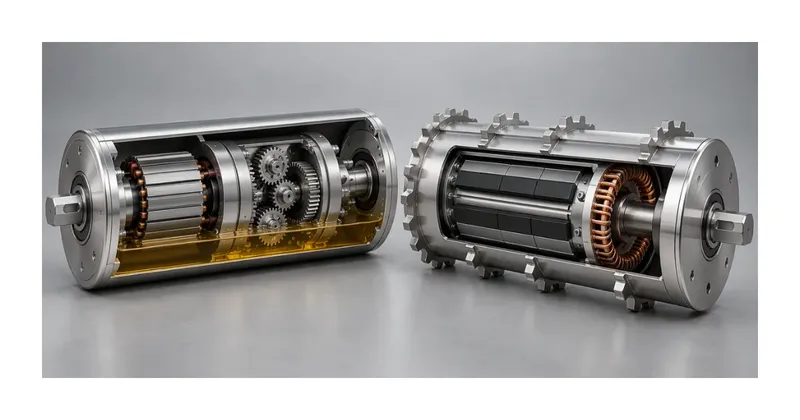
Gearmotors are easy to buy and service but add many external parts and an oil-filled gearbox. Drum motors hide the drive inside the pulley, but keep gears and usually oil in a sealed shell. Direct drive removes the gearbox entirely. For washdown food conveyors, direct drive gives the fewest wear parts, no oil and the widest speed range from one unit.
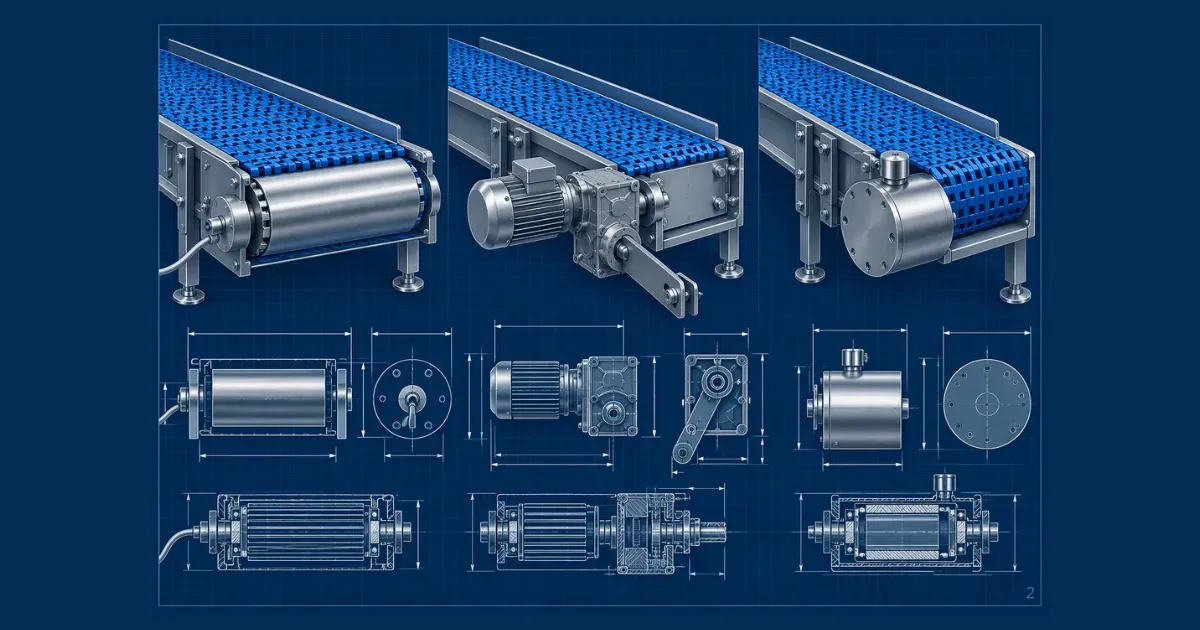
How do the three conveyor drive architectures differ?
Every belt conveyor in a food plant needs the same thing: enough torque at the head pulley to move the belt and product at the right speed. There are three common ways to get it.
An external gearmotor is a standard induction motor, usually spinning around 1,750 rpm on 60 Hz power, bolted to a gear reducer that slows it down and multiplies torque. The reducer is mounted on the conveyor shaft, often with a hollow bore and a torque arm.
A drum motor, also called a motorized pulley, puts the motor, the gear stage and the bearings inside the head pulley itself. The shell turns and drives the belt. From the outside it looks clean and compact.
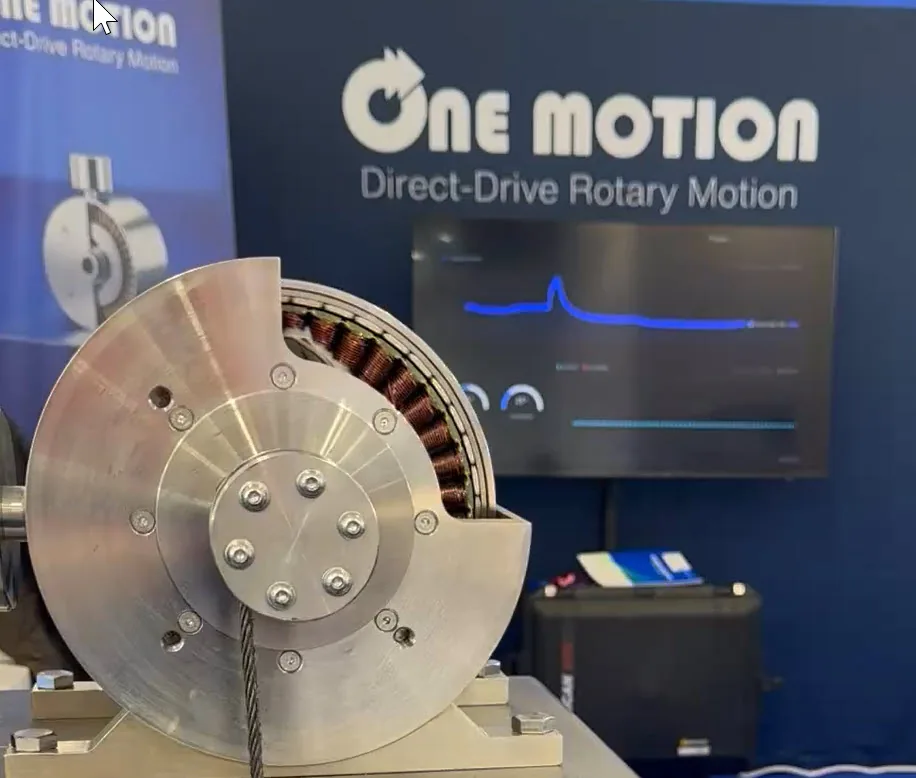
A direct drive makes low-speed, high torque without any reduction. In One Motion products this comes from a permanent magnet outrunner design, where the magnets sit on the rotating part and torque is produced right at the load. SideDrive mounts on the shaft like a gearmotor. PulleyDrive replaces the head pulley like a drum motor. Neither contains a gearbox.
Side-by-side comparison
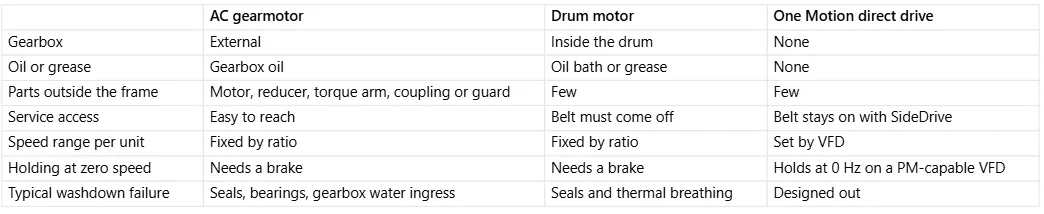
What fails in washdown with each one?
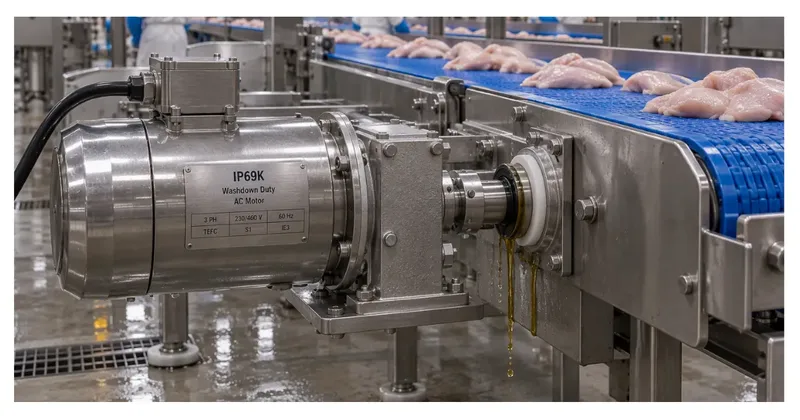
Gearmotors fail where water meets oil. The output seal and the breather are the weak points. Hot running followed by cold washdown pulls moist air into the gearbox, the oil emulsifies and the bearings follow. In most plants we visit, stainless gearmotors in direct spray last somewhere between one and two years.
Drum motors fail in a similar way, just out of sight. The shell heats during production, sanitation cools it fast and the internal pressure drop draws water past the seals. Because the drive is inside the pulley, the first symptom is often oil on the belt or a thermal trip.
A gearless direct drive removes the oil, the gear stage and the breather. There is nothing inside for water to contaminate, and with no gear losses the unit runs cooler, so the pressure swing that drives breathing is much smaller. One Motion drives are designed for no more than a 50 degree Fahrenheit rise at full load.
How do they compare on energy and speed range?
A gearmotor converts electrical energy into motor torque, then loses part of it in every gear stage. Worm reducers at high ratios lose the most. Drum motors avoid the external coupling losses but still carry internal gear losses. A direct drive has no gear stage, so the motor is the whole drive train.
Speed range follows the same logic. With gears, each ratio gives you one speed window. With direct drive, the VFD sets the speed. One SideDrive covers the territory of 1 HP gearmotors from roughly 5:1 to 30:1, running from 0 to 300 rpm with 40 Nm continuous and 120 Nm peak torque.
When does each one make sense?
-
Gearmotor: dry areas, very high power and applications where the plant already standardizes on a specific reducer family.
-
Drum motor: compact frames where space at the head is tight and the zone is not aggressively sanitized.
-
Direct drive: washdown zones, start-stop duty, inclines, and anywhere oil above product is a concern.
What should you ask before choosing?
Three questions usually decide it. How often does this position fail today? How many ratios do you stock to cover positions like it? And is the drive above open product? If the answers are often, many and yes, a gearless direct drive is the stronger choice.
Key takeaways
-
Gearmotors, drum motors and direct drives differ mainly in where the gearbox sits, or whether there is one.
-
In washdown, gear stages, oil and breathers are the first things to fail.
-
One gearless unit can replace several gearmotor ratios because the VFD sets speed.
Frequently asked questions
Are drum motors more efficient than gearmotors?
They avoid external chain and coupling losses, but still have gear losses inside the drum. A direct drive removes the gear stage completely.
Can I swap a gearmotor for a direct drive without changing the frame?
Yes. SideDrive mounts on the NEMA 56C face with the existing torque arm, so most swaps are a mechanical bolt-on plus a VFD parameter set.
Can I swap a drum motor for a direct drive pulley?
In most frames, yes. PulleyDrive is offered in standard diameters and face widths with sprockets matched to your belt.
Which option is best for an incline conveyor?
Direct drive, because a permanent magnet motor on a PM-capable VFD can hold the loaded belt at 0 Hz without a mechanical brake during normal stops.
Tell us which drive you run today and we will map the swap at onemotion.tech.
Found this useful? Share it with your team.