How One Direct Drive Mixer Replaced Five Pancake Batter Mixers and a 25 HP Motor
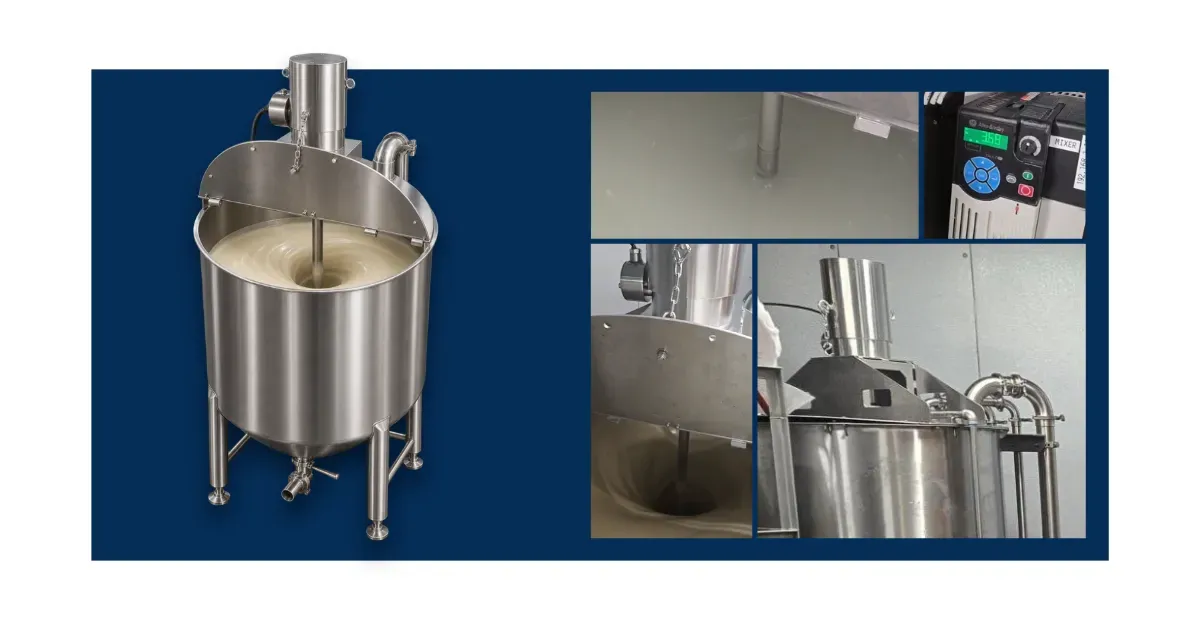
A food producer replaced five small 5 HP pancake batter mixers with one 250-gallon high-shear mixer. The usual option for a mixer that size was a 25 HP motor. Instead, it runs on a One Motion direct drive that turns a 12-inch high-shear blade at 1,300 RPM . In production it draws about 3.8 kW for a job sized at 17.5 kW, and its highest draw, 14 A for 10 minutes of each hour, stays below the motor's continuous current rating.
What was the customer trying to do?
The customer makes pancake batter at industrial scale. For years they did it the way many plants do: several small mixers running side by side, each with its own 5 HP motor. Five mixers meant five motors, five sets of controls, five operators , five vessels to clean and five places where a batch could come out slightly different.
They wanted to consolidate into one 250-gallon mixer with a 12-inch high-shear blade. Fewer vessels, one recipe point and one cleaning cycle. The question was how to drive it.
Why does a high-shear batter mixer need both speed and torque?
Pancake batter is harder to mix than it looks. Flour, liquid, eggs and other ingredients have to be wetted and dispersed quickly, without leaving lumps or dry pockets. A high-shear blade does that by spinning fast enough to create strong shear at the blade edge and a deep vortex that pulls ingredients down from the surface.
That takes speed. But a 12-inch blade in 250 gallons of thickening batter also meets a lot of resistance, especially when dry ingredients go in and viscosity climbs. That takes torque. A mixer like this needs both at the same time, and it needs them for the whole batch, not just at start-up.
Why was a 25 HP motor the default answer?
With conventional induction motors, the way to guarantee enough speed and torque in a large high-shear mixer is to size up. For this 250-gallon mixer, a 25 HP motor was previously the only option on the table. That is a lot of installed power, and most of it sits there waiting for the few moments of the batch that need it.
A large induction motor also brings large inrush current at start, a bigger electrical supply, bigger cabling and, in a food plant, a bigger housing to clean.
HSDrive™ | High-Speed High Torque Direct-Drive by One Motion (opens in a new tab)
What did One Motion install instead?
The mixer runs on a One Motion direct drive,This install was carried out by the team at Patriot Equipment (opens in a new tab) using model OS69-120-215-355-14406. (opens in a new tab) It is a permanent magnet direct drive rotary motor (DDRM) that turns the 12-inch high-shear blade directly, running at 1,300 RPM in production. It is controlled by a standard AB525 VFD, and the motor mounts on top of the vessel, as shown in the installation photos.
Because it is a permanent magnet motor, the rotor carries its own magnetic field. It does not need induced rotor current to make torque, so it can deliver the torque the batter needs at speed without the oversizing an induction motor would require.
What did the mixer actually draw in production?
These are the measured results from production on this mixer.
Measurement
Mixer size
Blade
Operating speed
Power in production
Job sized for
Highest current draw
Motor it replaced as the option
Mixers consolidated
250 gallons
12-inch high-shear
1,300 RPM
About 3.8 kW
17.5 kW
14 A, for 10 minutes of each one-hour cycle
25 HP
5 mixers with 5 HP motors each, replaced by 1
Put simply, the direct drive delivers the speed and torque the mixer needs while drawing about 3.8 kW. On those two figures, that is roughly 78 percent less power than the 17.5 kW the job was sized for.
Why does running below continuous current matter?
The highest draw we recorded was 14 A, for about 10 minutes of each hour-long cycle, during the heaviest part of the batch. Even then, the motor stayed below its continuous current rating. That means it is not leaning on short-term overload capacity to get through the hard part of the mix. It has headroom built in.
For the plant, headroom means less heat, a longer motor life and confidence that a heavier recipe or a fuller batch will not push the drive to its limit.
What did consolidating five mixers into one change?
-
One vessel to load, monitor and clean instead of five.
-
One recipe and one batch, which helps consistency from batch to batch.
-
One motor and one VFD to maintain instead of five sets.
-
3.8 kW in production on a single mixer, against 25 HP of installed motor power across the five small mixers it replaced.
What does this mean for other food mixers?
Batter is only one example. Many food mixers are sized with large induction motors because they need speed and torque at the same time, and the only conventional way to get both is to install more horsepower than the process uses most of the time. Sauces, dressings, dairy blends, brines and doughs all have similar demands.
A direct drive sized for torque at the operating speed can change that. This project shows a 250-gallon high-shear mixer running at 1,300 rpm on about 3.8 kW, below continuous current, on a standard VFD. If you are planning a larger mixer or thinking about consolidating several small ones, we can look at your vessel, blade and recipe and size a drive for it.
Key takeaways
-
One 250-gallon high-shear mixer on a One Motion direct drive replaced five small mixers with 5 HP motors each.
-
The drive runs a 12-inch high-shear blade at 1,300 rpm, where a 25 HP motor was previously the only option.
-
In production it uses about 3.8 kW for a job sized at 17.5 kW, and peak current stays below the motor’s continuous rating.
Frequently asked questions
What motor runs this pancake batter mixer?
A One Motion direct drive, model OS69-120-215-355-14406, turning a 12-inch high-shear blade at 1,300 rpm.
How much power does the mixer use?
About 3.8 kW in production, for a job sized at 17.5 kW.
What is the peak current?
The highest draw is 14 A, for about 10 minutes of each one-hour cycle, and it stays below the motor’s continuous current rating.
What did the direct drive replace?
A 25 HP motor was previously the only option for this mixer. The new mixer also replaced five smaller mixers that each ran a 5 HP motor.
Can One Motion drive other mixers?
Yes. Send us your vessel size, blade type, speed and recipe, and our engineers will size a drive for it.
Planning a bigger mixer or consolidating small ones? Send us your vessel and recipe at onemotion.tech.
Found this useful? Share it with your team.