Sensorless Position Control
Food manufacturing inherited the wrong motion architecture. Why direct drive with sensorless control replaces the servo, encoder and gearbox stack.
And the cost is showing up in reliability, sanitation, and capital spend.
The Hook
Servo systems didn’t come from food manufacturing.
They came from machine tools and robotics, a world that demands 0.001° positioning, high RPM, and tight feedback loops.
Food manufacturing didn’t need that. Food manufacturing needed reliability, hygiene, and total cost control.
But the industry adopted the servo stack anyway, and we’ve been paying for it ever since.
The Servo Stack Is a Chain of Compensations
A servo system isn’t one product. It’s a stack:
- High-speed PMSM servo motor
- Encoder for feedback
- Planetary gearbox to convert speed into torque
- Servo drive to manage the loop
Each piece exists to solve a problem caused by the previous piece.
That’s not engineering elegance. That’s architectural debt.
And in food manufacturing, especially washdown, it shows up as:
- Encoder failures
- Gearbox seal wear
- Sanitation risks
- Expensive stainless variants
- High spare parts inventory
- Downtime during sanitation-sensitive failures
The Reframe
The right question isn’t:
“How do we make the servo stack cleaner and more reliable?”
The right question is:
“Do we even need the stack?”
That’s where One Motion changes the conversation.
DDRM + Lenze i650: A Different Architecture
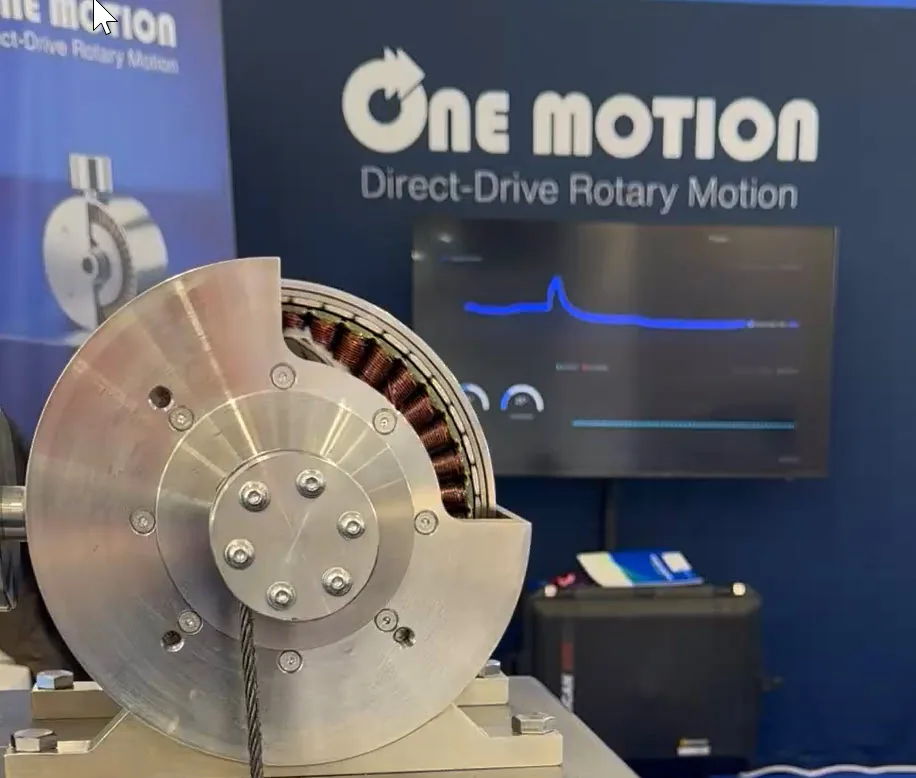
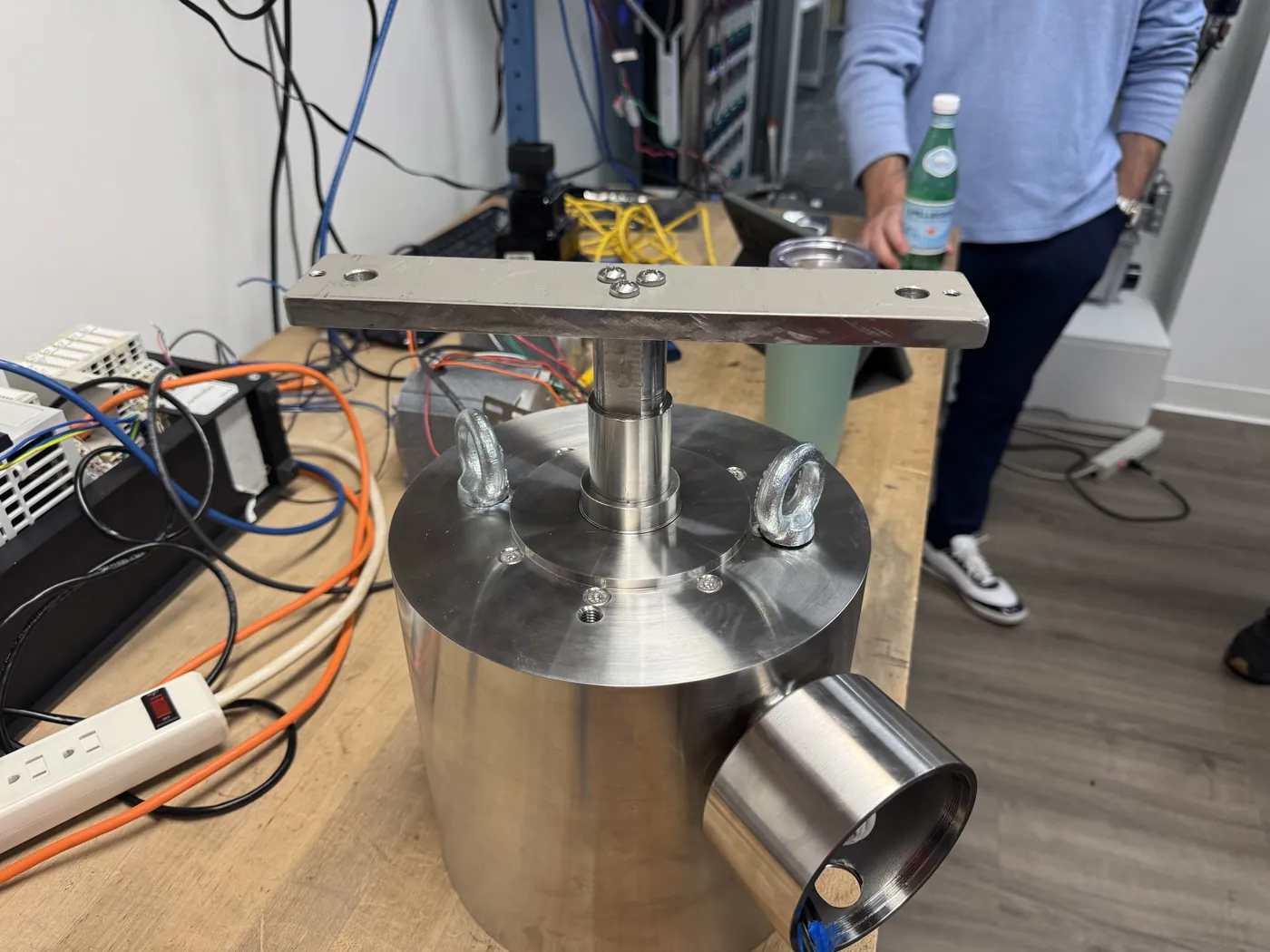
One Motion DDRM (Direct Drive Rotary Motion) is a large-diameter PMSM built to deliver torque directly to the shaft. No gearbox, no speed-to-torque conversion, no compromise.
Pair it with the Lenze i650 sensorless inverter, and the system becomes:
- Encoderless
- Gearbox-free
- Sensorless vector controlled
- Hygienic by design
This isn’t a smaller, cleaner servo system.
It’s a fundamentally different architecture.
So How Does the i650 Know Where the Rotor Is Without an Encoder?
This is the question every serious engineer asks. The answer is the technical backbone of the entire architecture.
The Lenze i650 uses SLPSM (SensorLess control of Permanent Synchronous Machine), a control technique that reconstructs rotor position in real time using a mathematical model of the motor and measured electrical signals.
It doesn’t measure the rotor. It calculates it.
The Motor Model Inside the Drive
The drive carries a digital twin of the motor in firmware:
- Stator resistance
- Stator inductance (Ld, Lq)
- Back-EMF constant
- Pole pairs
- Rated voltage and frequency
The i650 measures two things continuously:
- Stator currents (Iu, Iv, Iw)
- Stator voltages (commanded by the drive)
It runs these through the model and back-calculates where the rotor must be for the measured electrical behavior to be physically possible.
This is Field-Oriented Control without a sensor.
Two Operating Regions (This Is the Engineering Art)
The physics of sensorless estimation changes with speed, so the i650 runs two different strategies.
At standstill and very low speed:
- There is almost no back-EMF
- The drive injects a controlled current
- The rotor is pulled into a known reference position
- Motion begins from a known angle
Lenze’s newer firmware also includes pole position identification without motion, which locks the angle before any movement, eliminating start-up jerk. Critical when a DDRM starts with product already on the belt.
At medium and higher speed:
- Back-EMF becomes strong enough to observe
- The drive switches to a closed-loop back-EMF observer
- The observer locks onto the rotor flux angle
- Speed is derived from angle change over time
This is true Field-Oriented Control: only the current required for the demanded torque is injected, and rotor position is tracked continuously.
The Observer in Plain Terms
The observer is the math at the heart of sensorless control:
- Measure the actual current
- Predict what the current should be based on the model
- Compare actual vs predicted
- Use the error to estimate back-EMF
- From back-EMF, calculate rotor angle
- From rotor angle over time, calculate speed
The result is real-time rotor tracking using nothing more than the electrical signals already inside the drive.
No encoder. No feedback cable. No alignment.
Why This Works So Well With DDRM
Sensorless control is hardest at high RPM with narrow torque margins. That is servo territory, which is exactly why servos need encoders.
Sensorless control is easiest at low RPM with wide torque margins. That is DDRM territory.
The large-diameter PMSM rotor in DDRM produces:
- Strong back-EMF at low speed
- High signal-to-noise ratio for the observer
- Stable estimation under load changes
DDRM operates exactly where the i650’s observer is most accurate and most stable.
This isn’t a workaround. It’s a physics match.
The Reliability Math (Field Reality)
Reliability isn’t earned by adding protection. It’s earned by removing components, and the field data proves it.
In washdown food environments:
- Servo systems average ~1 year of service life before encoder, gearbox seal, or feedback failures force replacement or rebuild.
- One Motion DDRM averages 5+ years of service life, with no encoder to fail and no gearbox to wear.
That’s not a small improvement. That’s a 5× lifecycle multiplier.
What This Means at Fleet Scale
For a plant running 1,000 motion axes:
Servo stack (1-year life):
- ~1,000 replacements over 5 years
- Continuous spare parts consumption
- Recurring sanitation-driven downtime
- Ongoing capital reinvestment
DDRM + i650 (5-year life):
- ~200 replacements over 5 years
- Minimal spare parts churn
- Predictable maintenance cycles
- Capital deployed once, not annually
That’s an 80% reduction in motion system replacements over a 5-year horizon.
Why the Gap Is So Large
It comes back to architecture:
- Servo systems fail at their weakest layer: encoder, gearbox seal, or feedback cable.
- DDRM has no weakest layer: no encoder, no gearbox, no wear-driven mechanical interface.
Reliability isn’t a feature you add. It’s a result of what you remove.
Washdown Servo Is Structurally Expensive
The cost stacks at every layer:
- Stainless servo body
- Hygienic encoder housing
- Stainless planetary gearbox
- Washdown cabling
- Specialty connectors
This isn’t a pricing problem. It’s an architecture problem.
DDRM removes the architecture that requires those premium parts in the first place.
Total Cost of Ownership Tells the Real Story
A servo system has hidden costs:
- Encoder replacements
- Gearbox oil service
- Multi-SKU spare parts
- Specialized service labor
- Sanitation-driven downtime
DDRM + i650 changes the curve:
- One motor SKU
- One drive SKU
- No oil
- No encoder
- Standardized service
For food manufacturers running 24/7 shifts, this isn’t a 10% improvement.
It’s a structural cost reset.
The Big Picture
Direct-drive disruption has already happened in other industries:
- Tesla vs combustion drivetrain
- Solid-state drives vs hard drives
- Direct-drive washing machines vs belt-driven
In each case, the disruptor didn’t make the old architecture better. They removed the layers that justified it.
One Motion is doing the same thing for food manufacturing motion.
Found this useful? Share it with your team.