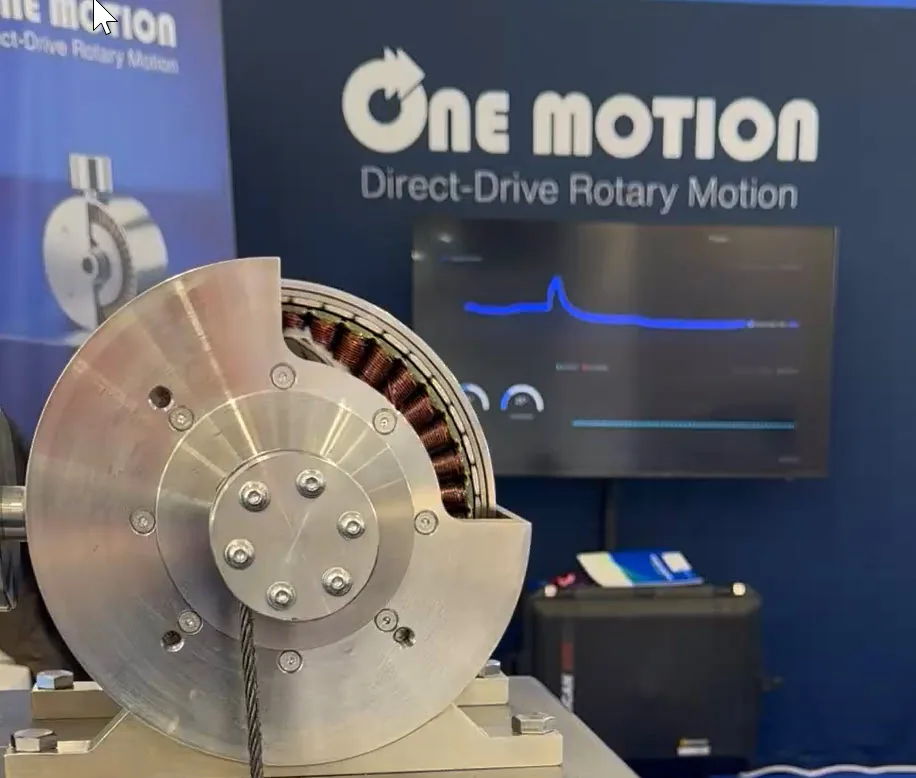
How One Motion® Direct Drive Rotary Motion Transforms Spiral Conveyors
How a spiral conveyor built on independent One Motion DDRM drives gets precise belt control, low energy use, less wear and a compact footprint.
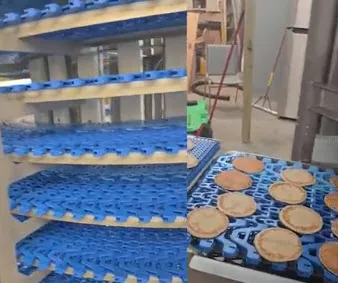
This spiral system is a great example of how One Motion Direct Drive Rotary Motion (DDRM) changes spiral conveyor performance—delivering precise belt control, ultra‑low energy use, reduced wear, and an industry‑leading compact footprint.
System Overview
- Infeed Conveyor: 20” wide × 9 ft long belt feeding product from the oven into the spiral
- Spiral Conveyor:
- Over 225 feet of belt travel
- 10 minutes 45 seconds dwell time from entry to exit 18” wide spiral belt 1.3 radius collapse
- Frame‑to‑frame width: 91 inches (ultra‑compact compared to typical 1.7–2.2 radius spirals)
- Line Speed: Approximately 21 ft/min
- Electrical Load (Entire System): Roughly 1.29–1.3 amps at 480V during operation (as captured in the walkthrough transcript) 625 watts!
The One Motion Drive Architecture (What’s Different)
Instead of a single large drive system with mechanical compromises, this spiral uses multiple independent One Motion DDRM devices so each function can be tuned precisely:
- Center cage drive (torque‑multiplied through a gearbox)
- Belt overdrive (direct-drive to the belt, no gearbox)
- Takeaway + auxiliary conveyors (powered pulleys)
That architecture is what enables stability, efficiency, and simplified maintenance.
Center Cage Drive (One Motion SideDrive 12168 + 50:1 Gearbox)
The center cage is driven by a 12168 SideDrive through a 50:1 gearbox.
Torque Reality (Using Kt and Measured Current)
- Kt (12168): 13.65 Nm/A
- Measured current: ~1.3 A
- Motor torque being used:
13.65 Nm/A×1.3 A=17.75 Nm
The 12168 is capable of:
- 40 Nm continuous
- 120 Nm peak
So the cage is running well below continuous rating, which is exactly where efficiency and temperature performance are best.
Torque at the Cage (After 50:1 Gearbox)
117.75Nm × 50 = 887Nm
✅ Result: The cage is seeing roughly 887 Nm, produced from very low motor current.
Why this matters: the spiral is not being “muscle-driven.” It’s being torque-regulated, which is the foundation for stable belt tracking and minimal mechanical stress.
Overdrive Belt Control (One Motion SideDrive 12167 — Direct Drive, No Gearbox)
The overdrive is powered by our One Motion SideDrive 12167, and this is a key difference versus conventional spiral architectures:
- Motor: 12167 SideDrive
- Torque rating: 16.5 Nm continuous / 50 Nm peak
- Kt (12167): 9.75 Nm/A (your spec — integrated here as the governing torque/current relationship)
- Drive type: Direct-drive to the belt — no gearbox
Because this overdrive drives the belt directly, it delivers:
- Immediate, stable torque response
- Tight tension control
- Minimal slip-back
In the walkthrough, the belt shows virtually no rollback, and the weighted return roller remains stable, evidence of controlled torque and consistent belt tension.
Takeaway & Auxiliary Conveyors (Powered Pulleys)
After exiting the spiral, product transfers onto:
- A 20 ft takeaway belt
- A speed-up belt per stack
These conveyors run on powered pulleys (as described in the transcript walkthrough), keeping the drive package compact and hygienic while maintaining belt-centric control.
Controls & Visibility
This system is set up with:
- Real-time monitoring of current draw per motor
- RPM control, with planned conversion to feet-per-minute for belt-first operation
- A scalable control cabinet designed to accommodate many drives as the full system expands
This gives operators a simple interface today, with room for more advanced control strategies as the full line is built out.
Why This Spiral Is Different
1) Compact Footprint
A 1.3 radius collapse spiral belt enables a far smaller system footprint than typical designs.
2) Reduced Belt Wear
Fine torque control—especially at the cage and overdrive—means:
- No oscillation
- No slip-back
- Minimal paddle and belt wear
3) Minimal Maintenance + Washdown Ready
- Stainless construction
- Washdown-capable sanitary build
- Only a few accessible grease points on the spiral itself
- Fewer traditional failure components (gear motors, external reducers, complex mechanical tension systems)
The Result
This spiral is:
- Quiet (you mainly hear the belt)
- Energy-efficient (very low running current)
- Stable (torque-controlled belt behavior)
- Compact (tight radius footprint)
- Low-maintenance (simplified mechanical system)
This specific build supports a protein pancake application, but the same DDRM architecture scales directly to cooling, freezing, buffering, and accumulation spirals across hygienic food processing.
Bottom Line
One Motion Direct Drive Rotary Motion doesn’t just power the spiral — it controls it. By separating cage torque multiplication (12168 + gearbox) from belt stabilization (12167 direct-drive overdrive), the system achieves high torque where it’s needed and precision where it matters—without wasted energy or unnecessary wear.
Why the Weighted Return Stays Still (And Why That Matters)
In a spiral conveyor, the overdrive system directly determines how much pull force is applied to the belt, which in turn defines how tightly the belt is pulling against the center cage drive.
In traditional spiral systems, this relationship is loosely controlled. The overdrive pulls the belt, the cage drive slips slightly, and the system constantly “hunts” for balance. That instability shows up clearly in the weighted return loop, which is normally seen moving up and down as belt tension fluctuates.
What Happens in the One Motion‑Driven System
In this system, the One Motion SideDrive overdrive and the center cage drive are tightly synchronized through precise torque control:
- The overdrive (12167) applies only the pull force required to stabilize belt tension
- The cage drive (12168 + gearbox) supplies regulated torque to rotate the spiral cage
- Neither drive overshoots or fights the other
Because both torque outputs are smooth, predictable, and tightly controlled, the system reaches a true equilibrium.
Observable Proof: The Weighted Return
The result is immediately visible.
- The weighted return loop remains steady
- There is no oscillation
- No vertical movement caused by slip‑pull‑release cycles
This lack of movement is not incidental—it is direct evidence that:
- The overdrive is not over‑pulling the belt
- The cage drive is not slipping
- Belt tension is stable and continuously controlled
In other words, the system is not reacting to instability—it is preventing it.
Why This Is Important
When the weighted return is stable:
- Belt tension remains consistent
- Paddle loading is uniform
- Wear on the belt and spiral structure is dramatically reduced
- Shock loads are eliminated
- Noise and energy consumption drop
This is the practical advantage of torque‑based synchronization instead of traditional speed‑based or mechanically biased spiral drive systems.
Bottom Line
The steady weighted return is the clearest visual indicator that the overdrive pull force and cage torque are precisely matched. That level of control is only possible because One Motion Direct Drive Rotary Motion delivers fine, real‑time torque regulation, not just rotation.
The spiral isn’t being forced to behave correctly. It’s designed to behave correctly.
Found this useful? Share it with your team.